
The Mid-Year Reset Your Team Needs
Mid-year is a natural checkpoint.
A moment to step back, take stock, and look realistically at how the year is unfolding.
What’s gaining traction.
What’s evolved.
What needs to shift to support what comes next.
This is where a reset becomes valuable.
Not as a restart—but as a way to realign priorities, refocus teams, and move forward with greater clarity.
In this HOST Blog, we’re breaking down the mid-year reset your team needs—and how to use it to build stronger momentum for the second half of the year.
THE MID-YEAR DRIFT HITS
Mid-year changes the pace.
Summer schedules pick up.
Time off increases.
Out-of-office replies stack up.
Work keeps moving—just not always at the same speed.
Projects pause.
Timelines stretch.
“Let’s circle back next week” shows up more often.
Nothing is off track.
The rhythm has just changed.
And that’s where momentum softens.
Quietly. Gradually. And often without being addressed.
MID-YEAR RESET BREAKDOWN
A mid-year reset isn’t about starting over.
It’s about stepping back to understand what’s working—and what needs to shift.
At its core, it comes down to three things:
→ Priorities
What still matters. What has changed. What no longer needs the same focus.
→ Alignment
Clear direction, expectations, and how work connects across the team.
→ Momentum
Rebuilding consistency so progress carries through the second half of the year.
It’s not a full reset.
It’s a recalibration—so teams can move forward with clarity and purpose.
RESETS BY TEAM TYPE
When the pace shifts and priorities start to stack up, this is where a reset makes a difference.
Not as a major initiative.
As a few intentional moments that bring teams back into alignment.
Reset moments don’t have to be all meetings and working sessions.
They can—and should—create space for teams to reconnect.
What that looks like depends on how your team works.

Bring teams together to revisit priorities and decide what stays, shifts, or stops.
THINK: a working session with leadership mapping priorities on a whiteboard, team breakouts to align on next steps, or a live “stop/start/continue” exercise.
→ Break the routine:
Pull teams out of day-to-day work to reset energy and bring them back together.
THINK: a wellness workshop, CSR build, team offsite, or an interactive experience that gets people out of meeting mode.
→ Make priorities visible:
Ensure updated goals and direction are reflected in the spaces teams interact with daily.
THINK: refreshed dashboards, updated team boards, new KPIs displayed in shared spaces, or leadership walkthroughs reinforcing what’s changed.

Move beyond slide-heavy meetings and build a session that drives interaction and alignment.
THINK: a live virtual reset with breakout discussions, team polls, and real-time prioritization exercises instead of a one-way presentation.
→ Create a shared moment:
Bring teams together through a coordinated experience—even across locations.
THINK: a shipped experience kit, guided tasting, or hands-on activity where everyone participates at the same time from wherever they are.
→ Reset in phases:
Reinforce alignment over time instead of relying on one single session.
THINK: a three-part reset with a kickoff session, follow-up team check-ins, and a final touchpoint to reinforce priorities and next steps.
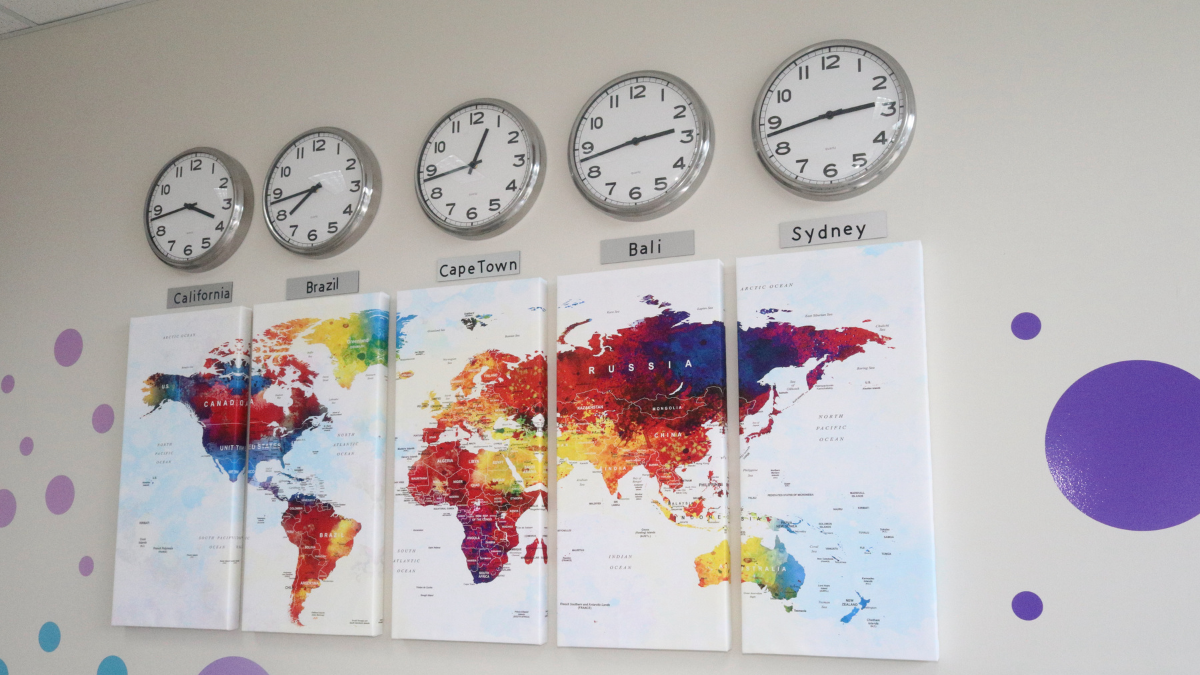
Plan reset moments around regional schedules, holidays, and seasonal differences—not a single global time.
THINK: separate reset sessions by region (AMER, EMEA, APAC) scheduled within local working hours instead of forcing one all-hands time.
→ Localize the experience:
Align on a central message while allowing regions to engage in ways that fit their teams.
THINK: one global reset theme supported by region-specific activations, local facilitators, or culturally relevant experiences.
→ Create connected moments:
Build a shared reset across regions—even if participation happens at different times.
THINK: a “follow-the-sun” rollout where each region participates, shares outputs, and contributes to a collective outcome or recap.
RESET RESULTS
When teams reset intentionally, the shift is immediate.
Momentum becomes more consistent.
Direction becomes clearer.
Priorities feel more manageable.
Work moves forward with fewer stops and starts.
Teams with clearly defined priorities are up to 3.5x more likely to outperform their peers¹.
Motivation follows.
Not from adding more—
but from removing the friction that builds over time.
Teams feel more connected to the work.
More aligned with each other.
More confident in what comes next.
That’s what supports sustainable performance.
Not a single reset moment—
but the consistency that comes from it.
FINAL THOUGHTS
A mid-year reset doesn’t need to be complex to be effective.
It needs to be intentional.
A structured moment to step back.
Realign what matters.
Reconnect teams to the work ahead.
We’re used to planning for the start of the year.
And wrapping things up at the end.
The mid-year reset is what bridges the two.
A defined point in the calendar that keeps momentum, alignment, and performance moving forward.
Because momentum doesn’t carry itself through the year.
It’s maintained through clarity, consistency, and shared direction.
When teams have that, performance becomes easier to sustain—
not as a one-time push—
but as the standard teams operate from.
1 Gallup. (2024). Strategy Execution and Organizational Performance. Retrieved from https://www.gallup.com